
How to Clean Black and White Truffles Without Damaging Them
When you buy a fine product such as a Tuber magnatum Pico (white truffle), a Tuber melanosporum (black winter truffle), or other truffle varieties, cleaning it properly is essential to enjoy its full flavor. The cleaning process is not trivial: if done incorrectly, it can compromise the aroma, texture, and even the shelf life of the fungus.
In this detailed guide, we’ll explore how to safely clean truffles, what specific care to take with black and white truffles, and why the harvest season—such as autumn—matters for the product’s quality.
Why It’s Important to Know How to Clean a Truffle
Truffles are hypogeous fungi with delicate characteristics. Their outer layer (the peridium) easily collects soil, debris, forest residues, and fine roots.
If not handled correctly, residual moisture, contact with water, or overly vigorous scrubbing can alter their aroma and internal texture (the gleba).
A properly cleaned truffle reveals its full sensory potential and the seasonal qualities that led to its ripening. Good cleaning practices are essential for an excellent gastronomic experience.
How to Recognize Truffle Quality
Before thinking about how to clean it, check the truffle’s condition. For white truffles, aroma and ripeness peak in autumn.
Make sure there’s no mold and that the surface has no soft or blackened areas. A damaged truffle won’t improve with cleaning—quite the opposite. Once purchased, the preparation process must begin carefully.
Useful Tools and Tips
To clean truffles properly, you’ll need a few simple but suitable tools:
-
A soft-bristled brush
-
A small spatula or sharp (non-serrated) knife to remove thin roots
-
A bowl of cold water
-
A clean towel or paper towels
Avoid soaking truffles or washing them harshly: water can penetrate the gleba and alter the aroma. Every movement should be gentle, respecting the structure of the fungus.
How to Clean White Truffles
White truffles are particularly delicate—both for their intense fragrance and their often softer gleba.
First, gently remove loose soil with a soft brush. Fine roots or small bits of forest debris can be detached with a small spatula or knife, being careful not to cut the surface.
Next, briefly rinse the truffle under a thin stream of cold water for just a few seconds, then dry it carefully with paper towels or a clean cloth.
The rinse should be quick—just enough to remove visible dirt, not to soak the truffle. Wrap it in dry paper towels and store it in the refrigerator within a few hours of purchase. Use it as soon as possible, as white truffles have a short shelf life.
Following this method ensures proper cleaning while preserving the truffle’s natural aroma.
How to Clean Black Truffles
Black truffles are sturdier than white ones, but they still require care to maintain their aroma and texture.
Start with a soft brush to remove loose soil, then use a knife or spatula to detach any stubborn debris or roots. You can be slightly more assertive than with white truffles, but avoid damaging the peridium or the gleba.
If necessary, rinse under a light stream of cold water, then dry immediately and thoroughly. Wrap the truffle in paper towels and store it in the fridge, changing the paper daily to prevent condensation.
A well-done cleaning greatly enhances the quality and longevity of black truffles, whose compact structure makes them more resistant but still sensitive to mishandling.
What to Avoid When Cleaning
No matter the variety, avoid these common mistakes:
-
Do not soak truffles or use hot water: soaking lets moisture in and ruins both aroma and texture.
-
Avoid hard brushes or metal tools that could scratch the surface and cause oxidation.
-
Do not store truffles in sealed plastic bags without paper towels: trapped humidity promotes mold and odor loss.
-
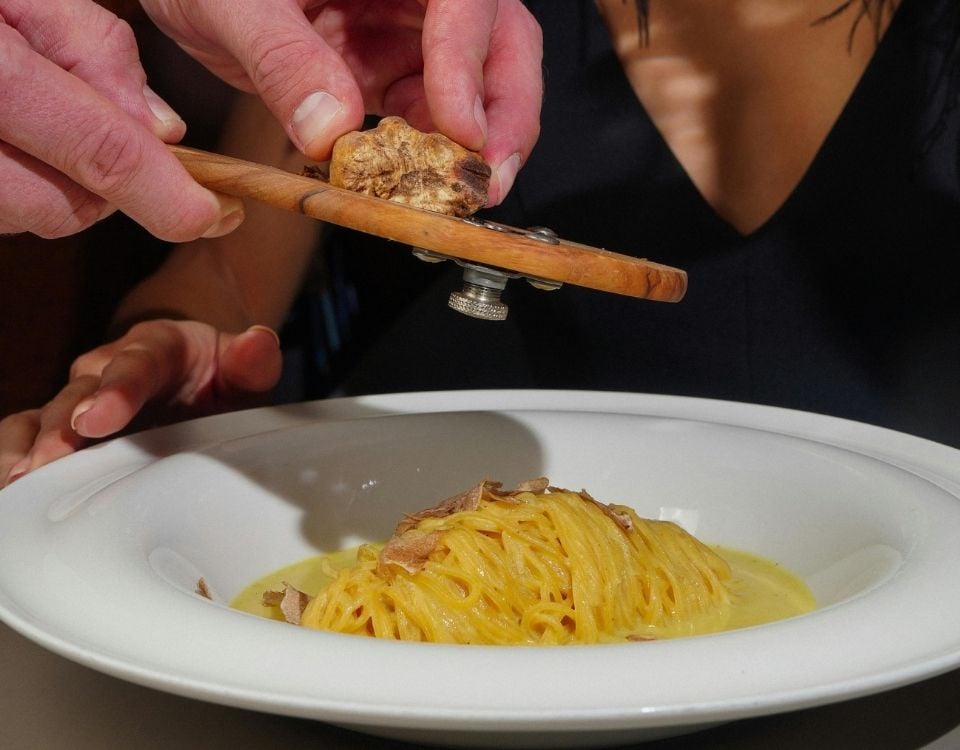
Do not slice or shave truffles too early: cut them only before serving to preserve their aroma.
-
Do not expose them to temperature swings: truffles prefer stable refrigeration until use.
How Seasonality Affects Cleaning and Quality
Harvest season and ripening conditions directly influence how truffles should be cleaned.
In autumn, soil humidity, cooler temperatures, and shorter days help the truffle develop a firm structure and rich aroma.
A truffle harvested under ideal conditions needs less cleaning and keeps better in storage and cooking. In other periods or under adverse weather, truffles can be more fragile, requiring extra care during cleaning.
Cleaning a truffle properly isn’t just about hygiene or appearance—it’s part of the journey that takes this extraordinary fungus from forest to table. The cleaning process directly affects its aroma, texture, and longevity.
For both white and black truffles, delicacy, speed, and correct storage are essential. By following these steps, every truffle-based dish becomes an authentic gastronomic experience: deep aroma, perfect texture, and incomparable flavor.
In a world where truffle quality and seasonality matter, mastering proper cleaning techniques means honoring both the product and its tradition.